Door Signs vs Reception Signs: What Your Office Actually Needs
Door plates and reception signs solve different problems. Compare materials, sizes, mounting and cost before you brief a sign maker.
“We need signage for the office” usually means two different jobs: a door sign that identifies a room or a person, and a reception sign that tells a visitor they have arrived at the right company. They are bought together, but they are not interchangeable.
Door signs: identification at close range
A door sign is read from about a metre away, usually while standing still. That makes legibility, not impact, the priority. The best office door plates are small, consistent and quietly expensive-looking: brushed stainless or 3 mm acrylic, with the name and title engraved or second-surface printed.
Standard sizes are 200 × 80 mm for a name plate and 300 × 100 mm for a room or department sign. Fix them at a consistent height — 1.5 m to the centre is a good default — and use the same material across every door. A corridor of mismatched plates looks worse than no plates at all.
Door signs are also the easiest signage to change. If tenants move or titles change, a plate can be re-engraved or replaced without touching the wall. That is why we recommend a standard plate size and a concealed fixing: the swap takes minutes.
Reception signs: arrival at mid range
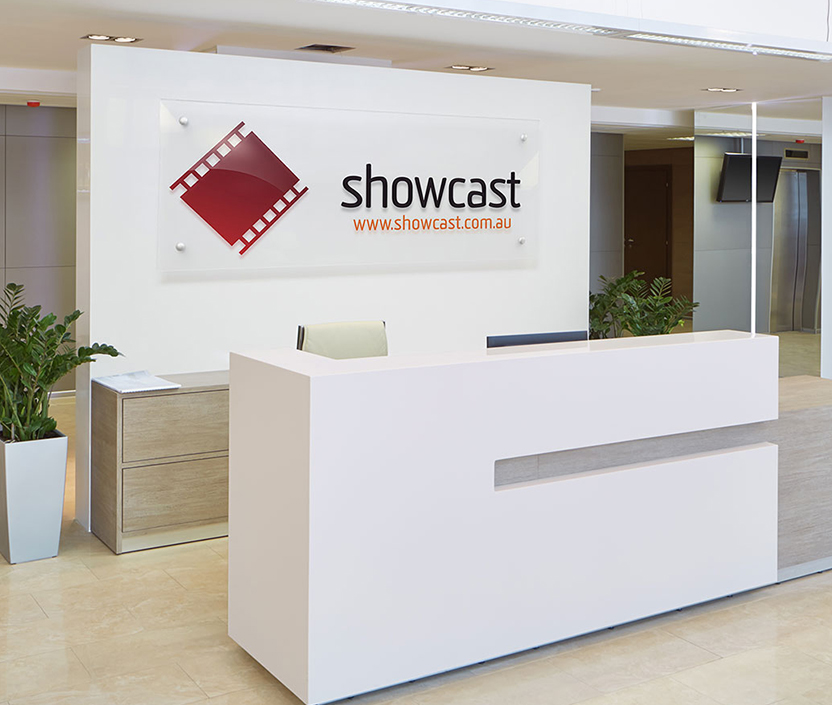
A reception sign is read from three to eight metres, often while walking. It has to carry the logo, establish the brand tone, and survive being photographed for a client's Instagram. That means scale and lighting matter more than fine text.
Typical reception treatments:
- Built-up logo on a feature wall: fabricated letters, unlit or halo-lit, mounted on a painted or timber wall.
- Acrylic logo panel: printed or cut acrylic on standoffs, with a subtle shadow gap.
- Backlit logo wall: a lightbox face or edge-lit acrylic panel when the reception has less daylight.
A reception sign usually costs more than a door plate because it is larger and because installation has to deal with cable routes, wall substrate and sightlines. The 3D and reception signs category has the current ranges.
Side-by-side comparison
| Door sign | Reception sign | |
|---|---|---|
| Reading distance | 0.5–1.5 m | 3–8 m |
| Typical size | 200 × 80 mm to 300 × 100 mm | 800 × 400 mm and up |
| Material | Brushed stainless, 3 mm acrylic | Fabricated letters, acrylic, lightbox |
| Lighting | Usually none | Often halo or backlit |
| Starting price | KSh 1,500 | KSh 7,200 |
The mistakes we see most
- Mixing finishes. Chrome plates next to brushed steel next to printed acrylic. Pick one finish and repeat it.
- Too much text on the door. A name, a title and a department is enough. Save the mission statement for the website.
- Ignoring the wall. A heavy reception sign on drywall needs anchors and a backer. A glass wall needs standoffs, not screws.
- Forgetting the window. The glass beside the door is prime signage space; a frosted window graphic can carry the logo, opening hours and privacy film in one install.
What to send for a quote
For door plates: the names and titles, the door finish, and a photo of one door. For a reception sign: the wall dimensions, a photo from the entrance, and your logo in vector format. Send both through the contact page and we will quote them as one job, which is usually cheaper than two separate orders.