Safety Signs in Kenya: ISO 7010, OSHA and What Inspectors Look For
A practical guide to safety signs in Kenya — ISO 7010 colours, OSHA expectations, material choices, sizes and the BoQ documents tender buyers ask for.
Safety signage is the part of a fit-out that nobody notices until an inspection. In Kenya, workplace safety signs are expected to follow ISO 7010 symbols and the standard colour code, and larger sites are often asked for a bill of quantities (BoQ) that matches the drawing. Getting the signs right is cheaper than failing an audit and re-doing them.
We fabricate safety signs in rigid PVC, acrylic and reflective film. This guide explains the system, not just the products.
The ISO 7010 colour code
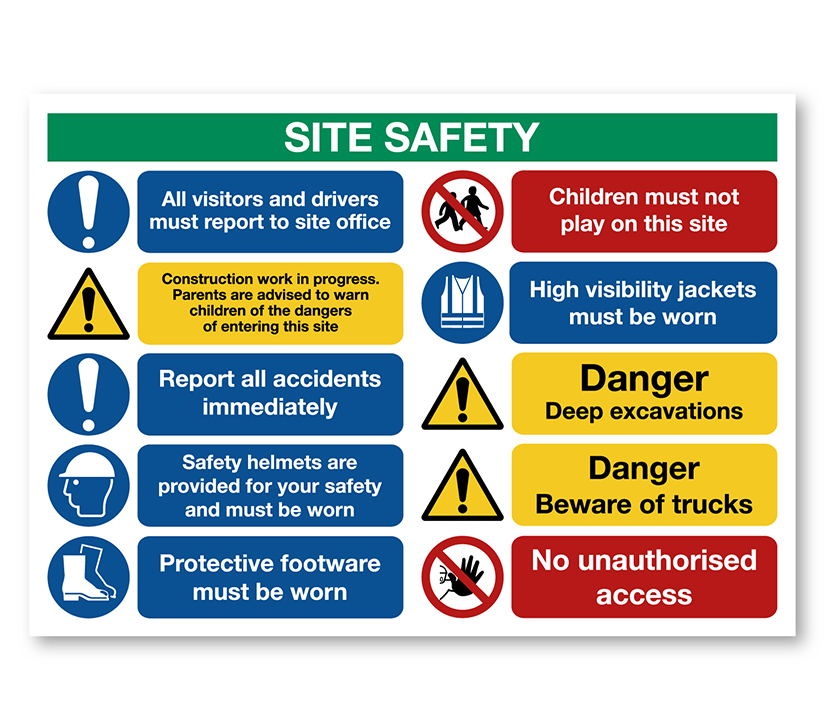
ISO 7010 uses shape and colour to communicate the type of message before anyone reads the text. Mixing them up is the most common compliance failure we see.
| Shape and colour | Meaning | Typical example |
|---|---|---|
| Red circle with a diagonal bar | Prohibition | No smoking, no entry |
| Yellow triangle with a black border | Warning | Wet floor, high voltage |
| Blue circle | Mandatory action | Wear PPE, keep clear |
| Green rectangle | Safe condition / emergency | Fire exit, first aid, assembly point |
| Red rectangle | Fire equipment | Fire extinguisher, hose reel |
A sign that uses the right symbol in the wrong colour is worse than no sign: it teaches people to ignore the system. Buy the set from one supplier so the pictograms, fonts and sizes are consistent.
Materials: what survives a Kenyan site
- Rigid PVC (3 mm): the default indoors. Cheap, light, easy to fix, and adequate for offices, schools and warehouses.
- Acrylic (3 mm): better looking and more durable; use it where the sign is part of the customer-facing fit-out.
- Reflective film on aluminium: for outdoor sites, car parks and anywhere the sign must be visible in headlights.
- Photoluminescent: for escape routes where power may fail; the sign glows after the lights go out.
For outdoor road signs, the spec is different again: KS 1623 geometry and Engineering Grade or High Intensity Prismatic reflective sheeting depending on the road class.
Sizes and mounting heights
There is no single legal size for every sign, but the practical rule is: the sign must be readable from the distance at which the hazard is encountered. A fire exit sign above a door is typically 300 × 150 mm; a mandatory PPE sign at a gate may be 400 × 600 mm. Mount emergency signs at 2 m to the centre and keep them unobstructed by stock, doors or plants.
Directional and wayfinding signs are a separate family — see the directional signs page — but they should use the same colour logic so the site reads as one system.
What inspectors and tender buyers ask for
- A sign schedule. A table of location, sign type, size and quantity. We can produce this from your floor plan.
- BS/ISO references. The standard each pictogram follows, usually ISO 7010 for safety and KS 1623 for road signage.
- Material specification. “PVC” is not enough for a tender; state thickness, finish and whether it is reflective.
- A BoQ with unit rates. We supply BoQ documents for tender compliance on request.
Ordering a set
Send a floor plan or a walkthrough video, the number of floors, and any audit findings you are responding to. We will mark up the plan with sign positions and quote the set. For multi-site rollouts, keep a master schedule so a new branch can be fitted out from the same list. Start with the safety, road and directional category, or send the brief through the contact page.